Longevity Research

Longevity Research
Through collaborative research with domestic and US research institutions using the PAI-1 inhibitor RS5614, we have revealed a series of findings suggesting the potential for preventing various age-related diseases and extending healthy life expectancy.
i. Cellular Senescence
Organismal cells cannot proliferate indefinitely due to a phenomenon called cellular senescence [i]. Cellular senescence involves shortening of gene telomere length [ii] and cell cycle regulators such as p53, p21, and p16ink4a [iii].
Senescent cells exhibit extremely high PAI-1 expression. PAI-1 inhibitors improve senescence biomarkers such as cell cycle regulators, senescence-associated secretory phenotypes (SASP) including IL-6 and other interleukins, and DNA damage response. This inhibits cellular senescence in cardiomyocytes, fibroblasts, and vascular endothelial cells (Oncotarget 2016).
Furthermore, PAI-1 inhibitors attenuate DNA damage in fibroblasts of patients with Hutchinson-Gilford syndrome (vii), a human progeria disorder, improve mitochondrial dysfunction, and enhance cellular senescence (Cell Death and Disease. 2022).
ii. Aging of Tissues and Individuals
High expression of PAI-1 has been reported not only in cells but also in aged tissues and individuals (klotho mice [viii], and humans with Werner syndrome [ix], a well-known progeria) (Proc Natl Acad Sci USA. 2014). In non-clinical studies using the klotho mouse, an aging (progeria) model, oral administration of PAI-1 inhibitors improved the aging symptoms in this model (Proc Natl Acad Sci USA. 2014).
iii. Diseases As we age, various diseases develop, including cancer, vascular diseases (arteriosclerosis), lung diseases (emphysema, chronic obstructive pulmonary disease), metabolic diseases (diabetes, obesity), kidney diseases (chronic kidney disease), musculoskeletal diseases (osteoporosis, osteoarthritis, sarcopenia), and brain diseases (cerebrovascular disease, Alzheimer’s disease/dementia).
Interestingly, PAI-1 expression is extremely high in these diseases, and the condition can be improved by administering the PAI-1 inhibitor RS5614 (Biomedical J, 2026).
RS5614 not only suppresses the progression of vascular aging, but it has also been shown to further improve symptoms compared to those before RS5614 administration (J Clin Invest. 2025). As the saying goes, “a person ages with their blood vessels,” and it is believed that blood vessels age with age, and this vascular aging greatly affects healthy life expectancy. Various modern lifestyle-related diseases (hypertension, diabetes, chronic kidney disease, hyperlipidemia) accelerate vascular aging.
The fact that PAI-1 inhibitors not only prevent vascular aging but can also reverse it is an extremely interesting finding.
iv Epidemiological study of long-lived families
In a joint study with Northwestern University in the United States, we investigated people in the Amish community[x] and found that people without the PAI-1 gene lived 10 years longer than those with it (Science Advances 2017). This fact was reported in many newspapers, including The New York Times in November 2017.
Furthermore, it was shown that mice with the same PAI-1 gene abnormality as Amish humans live approximately 20% longer than normal mice (J Clin Invest. 2025).
Based on the anti-aging effects of these PAI-1 inhibitors, we proposed the concept of “Senolytic drugs”—new small-molecule pharmaceuticals that remove senescent cells and suppress age-related diseases without promoting cancer—and applied to the XPRIZE Healthspan (https://www.xprize.org/prizes/healthspan) in collaboration with research institutions and medical institutions at Tohoku University, Tokai University, and Hiroshima University. The XPRIZE Healthspan, sponsored by the XPRIZE Foundation [xi], is a global longevity competition aiming to proactively extend healthy life expectancy by more than 10 years. It offers a total of US$100 million to research teams that can achieve this by 2030.
There were over 600 entries and more than 200 submitted applications from around the world. Treatment approaches proposed included small molecule drugs, biopharmaceuticals (exosomes, immunomodulators, antibody drugs), gene therapy, stem cell therapy, medical devices (digital health devices, electromedical devices, magnetic medical devices), supplements, functional foods, dietary restrictions, exercise therapy, and combinations thereof.
Our company was selected as one of the Top 40 (semi-finalists) at the XPRIZE Healthspan awards ceremony held in New York, USA, and received a prize of US$250,000 (timely disclosure on May 13, 2025). Subsequently, we conducted a specific clinical study to evaluate the anti-aging effects of the PAI-1 inhibitor RS5614
[Specified Clinical Research Evaluating Anti-Aging Effects]
An open-label clinical trial was conducted in which RS5614 was administered for 16 weeks to 20 subjects aged 50 to 75 who had stable, age-related conditions (hypertension, type 2 diabetes, chronic kidney disease, or hyperlipidemia).
While RS5614 has previously been administered to many cancer patients, there was no prior experience administering it to relatively healthy elderly individuals; therefore, confirming its safety was essential. Furthermore, given the very short administration period of four months—which made it difficult to directly assess anti-aging effects on various organs—the study analyzed changes in biomarkers2) associated with organ aging (including epigenomic markers, genes, proteins, and cells) across areas such as aging processes, immunity, metabolism, bone and muscle health, cognitive and neurophysiological function, antioxidant status, and hematopoietic stem cells.
Tohoku University served as the clinical trial site, with Hiroshima University and Tokai University participating as collaborating institutions for testing and other procedures. Nineteen patients (mean age: 60.4 ± 5.6 years; 13 men, 6 women) who underwent testing both before and after the four-month RS5614 administration period were included in the efficacy analysis, while all 20 patients who received RS5614 were included in the safety analysis.
While RS5614 has been administered to many cancer patients, there is no experience of administering it to relatively healthy elderly patients, so safety confirmation is necessary. Furthermore, due to the extremely short administration period of four months, it was considered difficult to evaluate the anti-aging effects on various organs. Therefore, we analyzed changes in biomarkers2) such as epigenetic modifications, genes, proteins, and cells involved in aging of various organs, including aging, immunity, metabolism, bone and muscle, cognitive and neurophysiological factors, antioxidant activity, and hematopoietic stem cells.
The study was conducted at Tohoku University, with Hiroshima University and Tokai University participating as cooperating institutions for testing and other services. Nineteen patients (average age 60.4 ± 5.6 years, 13 males, 6 females) for whom pre- and post-administration tests were available for four months of RS5614 administration were included in the efficacy evaluation, while 20 patients who received RS5614 were included in the safety evaluation.
Safety
One adverse event (mild liver dysfunction) that could not be ruled out as being causally related to RS5614 was observed, but no other serious side effects, including hemorrhagic events, were confirmed.
Efficacy
Although the administration period was relatively short at four months, findings suggesting systemic anti-aging were confirmed, including an average rejuvenation of biological age by 2-3 years, recovery of immune and regenerative functions, and a reduction in substances that promote aging.
Conclusion
Administration of the PAI-1 inhibitor RS5614 for four months resulted in improvements at the epigenetic (gene modification) or genetic level. Particularly noteworthy was the rejuvenation of biological age by 2-3 years. At the protein level, improvements were observed in multiple proteins involved in anti-aging effects, including improvements in immune function, bone and muscle function, metabolic function, and cognitive function. At the cellular level, functional recovery and rejuvenation of immune cells and hematopoietic stem cells were observed, and a reduction in systemic oxidative stress was also confirmed. RS5614 was not only confirmed to be safe for oral administration to relatively healthy elderly individuals, but despite a short four-month administration period, anti-aging effects were observed across a wide range of organs, including immunity, metabolism, bone and muscle, cognitive and neurophysiology, antioxidant activity, and hematopoietic stem cells It is of great interest to consider whether these molecular-level changes lead to anti-aging effects in various organs and ultimately contribute to extending healthy life expectancy.
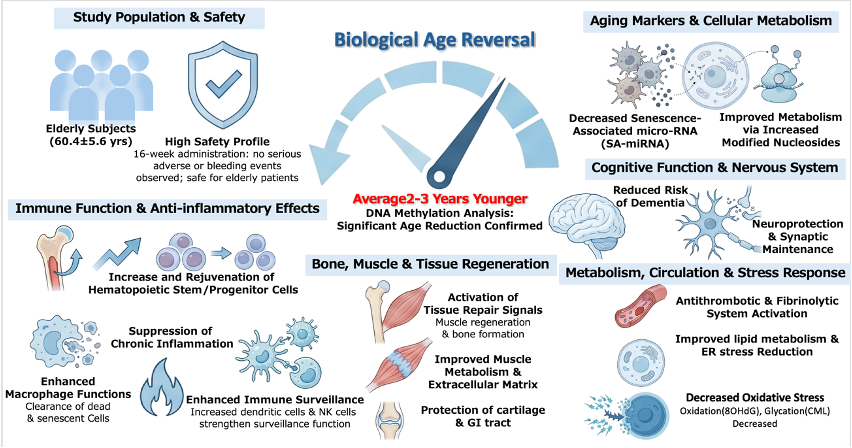
In this clinical trial, we confirmed a reduction in biological age of two to three years following the administration of RS5614, utilizing the epigenetic method (the “Horvath Clock”) developed by Dr. Steve Horvath. Dr. Horvath also developed “GrimAge”—a metric that incorporates factors such as smoking history and protein levels—which includes PAI-1 as a component. Our study results, involving the use of the PAI-1 inhibitor RS5614, represent the first direct investigation into whether the pharmacological inhibition of PAI-1 activity is causally linked to biological age.
We intend to leverage the insights gained from this trial in the future research and development of RS5614 within the anti-aging field, as well as in international collaborative research.
We compiled the results of this semi-final trial and the outline of the final trial and submitted them to the XPRIZE Healthspan Evaluation Committee in mid-April 2026. If selected as a finalist (TOP 10) in August 2026, the final trial will be conducted as an international collaborative clinical trial with Japan, the United States, Saudi Arabia, and Taiwan. It will be a placebo-controlled, blinded trial involving approximately 100-150 elderly participants, evaluating immune function, muscle function, and cognitive function. Furthermore, we plan to explore biomarkers of aging and investigate more accurate biological age assessment methods by conducting multi-omics analyses of genes (transcriptome), epigenome, and proteins (proteome) induced by RS5614 administration.
Traditional drug development is based on the premise of “single disease,” “single target,” and “clear evaluation indicators (endpoints).” On the other hand, “aging” is an extension of age (physiological changes) and is not considered a “disease.” Moreover, because aging is continuous and varies greatly from person to person, it is difficult to develop “aging” as a single disease (indication). Therefore, there are various challenges in commercialization, including regulations, clinical trial design, insurance reimbursement systems, and business models. However, in recent years, new aging interventions (treatments) based on novel mechanisms such as epigenetic reprogramming (cell rejuvenation) and senolistics (removal of senescent cells), which differ from conventional classical aging interventions (dietary therapy, exercise therapy, sleep therapy, supplements, etc.), have been proposed, and clinical trials are beginning in some cases.
The PAI-1 inhibitor RS5614 is an oral medication aimed at senolistics. Aging is a state in which the homeostasis of a wide range of biological systems, including epigenetic information, metabolism, inflammation, and stem cell function, is disrupted. Therefore, when intervening in aging, an integrated intervention spanning multiple pathways is necessary. It is important to take the perspective of “broadly improving the environment of aging and reconstructing the balance of the entire organism” rather than “improving a specific pathological condition.” When senescent cells are not removed by the immune system and accumulate, they continuously release inflammatory cytokines and chemokines called aging-related secretory traits, causing chronic inflammation in surrounding healthy cells and tissues. PAI-1 inhibitors are oral medications that intervene comprehensively across multiple pathways, capable of restoring disrupted homeostasis throughout the body. They are drug candidates that can improve the aging environment, eliminate senescent cells, reverse biological age, and prevent and treat various age-related diseases.
Furthermore, an article about our company’s cancer and anti-aging/longevity fields has been published in the scientific journal Nature (Digital Edition).
[i] Cellular Senescence: Organismal cells cannot proliferate indefinitely due to a phenomenon called cellular senescence. This phenomenon involves telomere shortening and cellular senescence factors such as p53. Sensed cells are known to have extremely high expression of PAI-1 in addition to p53. It has been shown that cellular senescence can be inhibited by suppressing p53 and PAI-1.
[ii] Telomere Length: Telomeres are structures located at the ends of chromosomes and are known to shorten with each cell division. Telomere length is closely related to cell lifespan and aging, and maintaining it plays an important role in health and the prevention of age-related diseases.
[iii] Cell Cycle Regulators: Senescent cells have a stopped cell cycle, but unlike quiescent cells, senescent cells do not restart the cell cycle regardless of physiological stimuli. Factors such as p53, p21, and p16ink4a are involved in cell cycle arrest and serve as biomarkers for senescent cells.
[iv] Senescence-associated β-galactosidase (SA-β-gal) staining: SA-β-gal is an acidic β-galactosidase that accumulates in lysosomes during the aging process. Since the activity of this enzyme increases in senescent cells, it is used as an indicator of aging.
[v] Senescence-associated secretory phenotype (SASP): This refers to a group of molecules secreted by senescent cells, including inflammatory cytokines such as IL-6, cytokines, chemokines, growth factors, and proteases. It is considered one of the aging biomarkers.
[vi] DNA damage response: DNA damage, such as double-strand breaks, is one of the characteristics of cellular senescence. Senescent cells exhibit a persistent DNA damage response, ultimately inducing cell cycle arrest.
[vii] Hutchinson-Gilford syndrome: Progeria is a general term for diseases in which the body ages faster than normal from a young age. This category includes approximately 10 diseases, such as Werner syndrome and Hutchinson-Gilford syndrome. Hutchinson-Gilford syndrome is a particularly severe form of hereditary progeria, often characterized by severe cerebrovascular and cardiovascular damage due to arteriosclerosis occurring in adolescence, with an average lifespan of 14.6 years.
[viii] Klotho mouse: Klotho mice have a short lifespan of 8-10 weeks and exhibit a variety of symptoms similar to human aging, such as osteoporosis and arteriosclerosis, during this short life. This phenotype is considered a type of progeria, and its potential as a model animal for human aging is attracting attention.
[ix] Werner syndrome: This is a type of progeria characterized by accelerated aging symptoms such as gray hair, cataracts, and intractable ulcers after puberty. It is an autosomal recessive genetic disorder.
[x] Amish: A group residing in the Midwestern United States and other areas, who maintain the lifestyle of their immigrant ancestors and live a self-sufficient life through agriculture and livestock farming.
[xi] XPRIZE Foundation: Sponsored by Elon Musk and others, this foundation hosts various globally challenging competitions with the mission of stimulating the creation of new industries and the revitalization of markets by bringing about fundamental breakthroughs for humanity.